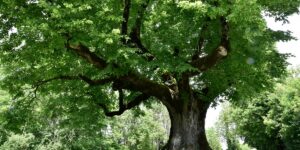
When most trees in Summit and Berkeley Heights are settling into a deep summer green in late May, a struggling pin oak can stick out. Leaves may come in pale yellow instead of healthy green, with dark veins that look almost painted on. Brown, scorched-looking edges from last year can also start showing up earlier than expected. If that sounds familiar, you’re not alone—pin oak problems are common throughout Union County.
Almost always, it’s one of three or four specific issues we see all over this part of New Jersey.
Key Takeaways
- The most common pin oak problem in Union County, NJ is iron chlorosis—which is caused by alkaline soil, identifiable by yellow leaves with green veins, and treatable through professional soil amendments or trunk injection.
- Bacterial leaf scorch (BLS) and oak wilt look similar to chlorosis at first glance but are fatal.
- Suburban developments in Summit and Berkeley Heights create exactly the soil conditions that cause pin oak chlorosis to worsen year after year.
- A Certified Arborist can confirm the diagnosis with a soil test and visual inspection before treatment begins.
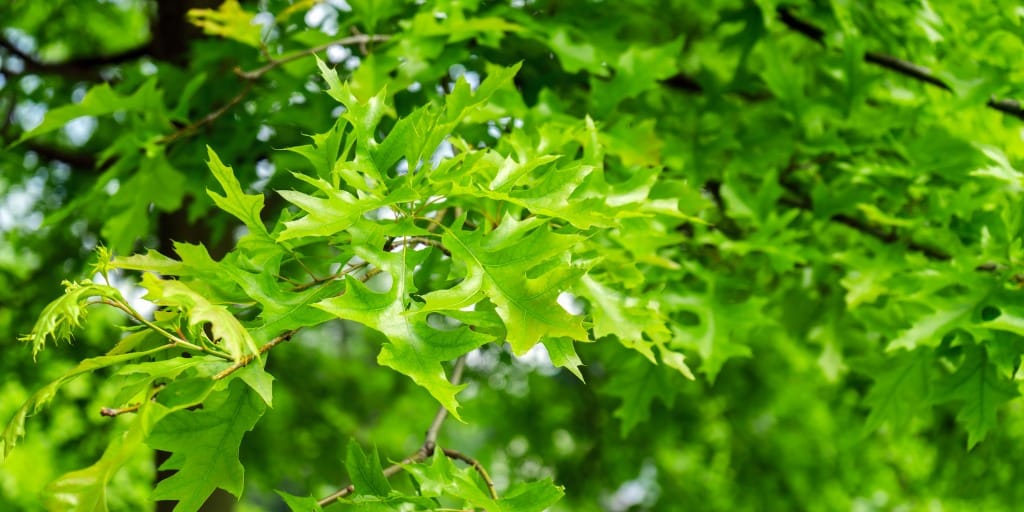
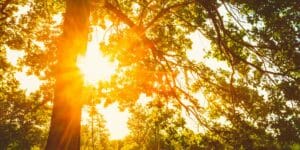
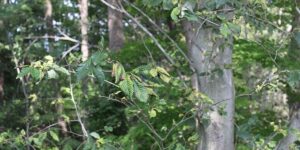
Healthy pin oak foliage shows uniform deep green color across the entire leaf—a sharp contrast to the yellow leaves with green veins that signal iron chlorosis.
Why Do Pin Oaks Struggle in Union County?
Pin oaks are one of the most commonly stressed mature trees in Union County because they’re naturally adapted to acidic bottomland soils, not the heavily altered suburban soils found throughout Summit, Berkeley Heights, and surrounding communities.
Over decades, construction activity, lime-based materials, compacted soil, and runoff from sidewalks and foundations gradually change soil chemistry around established trees. That stress alone can weaken a pin oak or contribute to problems like iron chlorosis, bacterial leaf scorch, decline from drought stress, and increased vulnerability to secondary pests and disease.
In many neighborhoods, mature pin oaks planted decades ago are only now reaching the point where those long-term site conditions start visibly affecting canopy health.
How Do You Tell Which Pin Oak Problem You Have?
The quickest way to figure out what’s wrong with your pin oak is to look at the pattern of damage on leaves themselves. Different problems leave different fingerprints:
- Iron Chlorosis: Yellow leaves with dark green veins across the entire canopy, gradually getting worse with time.
- Bacterial Leaf Scorch (BLS): Brown leaf margins with a yellow halo separating the dead tissue from the still-green interior. It shows up in late summer, starting on one branch before continually spreading.
- Oak Leaf Blister: Raised brown circular blisters on isolated leaves in spring, usually after a stretch of cool, wet weather.
In Union County, iron chlorosis and BLS are the two most common diagnoses by a large margin. Don’t try to make a diagnosis on your own; a Certified Arborist can distinguish from heat stress, drought, and herbicide drift, as they all can mimic the early stages of these problems. Such tree care professionals can explain how to tell if your oak has BLS and the wider view of diseases that threaten oak trees in New Jersey.
IMPORTANT: Oak wilt has not yet been confirmed in New Jersey, but it has been detected in nearby states, including Pennsylvania and New York. Because the disease can kill susceptible oaks rapidly once established, arborists across the region continue monitoring for symptoms and encouraging homeowners to avoid unnecessary oak pruning during the growing season.
What Is Iron Chlorosis in Pin Oaks?
In Union County, iron chlorosis is the most common pin oak problem. Despite how dramatic it looks, it isn’t a disease. It’s a nutrient absorption failure caused by soil pH, and it’s the reason most yellowing pin oaks in Summit and Berkeley Heights look the way they do.
When soil pH exceeds 7.5, pin oaks can no longer absorb iron, even when iron is present in the soil. Without iron, the tree can’t make chlorophyll. Without that, leaves can’t stay green. This results in the classic symptom most homeowners initially notice.
How to Recognize Iron Chlorosis
Iron chlorosis has a distinct look that separates it from most other pin oak problems:
- Leaves are yellow or pale green, but the veins stay dark green
- The whole canopy is affected, typically more severe on new growth at the branch tips
- In advanced cases, leaf margins turn brown, leaves curl, and branches start dying back
- Symptoms get worse year over year unless the underlying soil chemistry is corrected
Although iron chlorosis isn’t fatal on its own, it also isn’t harmless. Years of nutrient stress weaken the tree’s defense and make it more vulnerable to bacterial leaf scorch, borer infestations, and oak wilt if it shows up in the area.
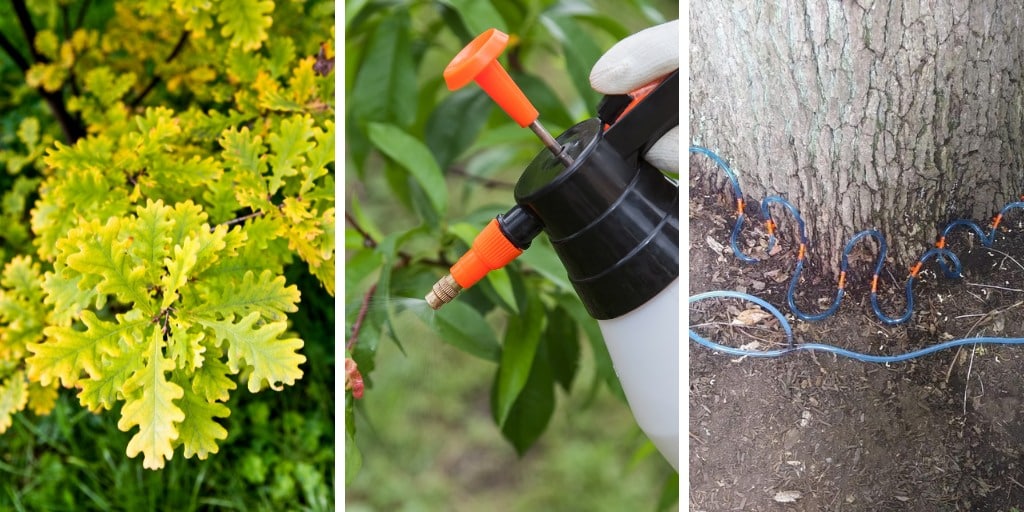
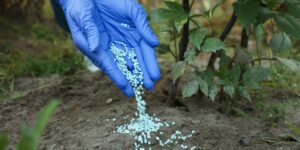
The three professional approaches to iron chlorosis treatment, left to right: chlorotic foliage showing classic yellow leaves with green veins, foliar iron spray for short-term green-up, and trunk injection for direct delivery into the tree’s vascular system.
Can Iron Chlorosis in Pin Oaks Be Treated?
Iron chlorosis can be treated, but every option trades off speed against longevity. There are three professional approaches, and the right one depends on how severe the chlorosis is and how soon you need to see results.
Foliar Iron Spray
Iron is directly sprayed onto the leaves, which absorb it and green up within days. The effect only reaches leaves the spray touches and only lasts the current season. Useful as a short-term cosmetic fix, but it doesn’t solve the underlying issue.
Soil Amendment
Granular sulfur or chelated iron is applied to the root zone to lower soil pH and free up iron the tree can absorb on its own. It’s slower to work, anywhere from weeks to an entire season to see results, but the effect lasts a lot longer. Chelated iron generally lasts two to three years, and granular sulfur applications can extend iron availability for several years when reapplied as necessary.
Trunk Injection
Iron is directly injected into the tree’s vascular system, completely avoiding soil chemistry. Green-up happens within a week, and the effects last two to three years. Trunk injection works best in spring during bud break and requires a Certified Arborist with the right equipment.
DIY iron supplements from a garden center rarely work for established pin oaks because they don’t address soil pH at the root zone. Professional treatment isn’t permanent on its own because soil chemistry doesn’t stay put. Long-term management means combining a soil-based approach with periodic reinforcement.
What Is Bacterial Leaf Scorch in Pin Oaks?
Along with iron chlorosis, bacterial leaf scorch is one of the most common pin oak diagnoses in Union County — though it’s generally far more difficult to manage long term. Unlike iron chlorosis, which comes from soil chemistry, BLS is caused by a bacteria that disrupts the tree’s ability to move water.
That’s why symptoms often resemble drought stress at first, especially during hot, dry weather. In mature pin oaks, the disease usually starts on one branch before gradually spreading through the canopy over several years.
How to Recognize Bacterial Leaf Scorch
BLS has a pretty recognizable pattern once symptoms fully develop:
- Brown leaf margins with a yellow or reddish band separating dead tissue from green tissue
- Symptoms appearing in mid-to-late summer, especially during heat stress
- Damage beginning on one branch or one side of the canopy before spreading year after year
- Early leaf drop while nearby healthy oaks stay green
Unlike temporary drought stress, BLS progressively worsens over time.
Can Bacterial Leaf Scorch Be Treated?
BLS cannot be cured, but it can sometimes be managed for years with professional care. Some infected pin oaks remain manageable for many years. Others decline more quickly depending on drought stress, site conditions, and overall tree health. Antibiotic trunk injections may slow symptom progression, while deep-root fertilization, mulching, and proper watering help reduce additional stress on the tree.
What Is Oak Leaf Blister on Pin Oaks?
Oak leaf blister is a common fungal leaf disease that shows up during cool, wet springs in New Jersey. Despite the alarming appearance, it’s usually the least serious pin oak problem. The fungus infects young leaves during spring bud break, causing distorted blister-like spots across the leaf surface. Most healthy mature pin oaks recover without long-term damage.
How to Recognize Oak Leaf Blister
Oak leaf blister looks very different from chlorosis or BLS:
- Raised or puckered brown spots scattered across leaves
- Symptoms appearing in spring rather than late summer
- Leaf distortion or curling during wet years
- Damage affecting isolated leaves instead of the entire canopy evenly
Because symptoms can appear suddenly after rainy weather, homeowners often mistake oak leaf blister for major decline when it’s usually temporary and cosmetic.
Can Oak Leaf Blister Be Treated?
Most mature pin oaks do not require treatment for oak leaf blister. Maintaining overall tree health is usually enough for recovery. For severe repeat infections on high-value trees, preventive fungicide treatments may help, but timing is critical because applications must happen around bud break before symptoms appear.
How Do You Protect a Pin Oak Long-Term?
Long-term pin oak care isn’t a one-time fix; it’s a multi-year management approach that keeps the tree ahead of the soil conditions working against it. For mature pin oaks in Summit and Berkeley Heights, the right routine typically combines several things:
- Annual or biannual soil tests to track pH at the root zone
- Targeted soil amendments based on test results
- Mulching to moderate soil temperature and moisture (without piling mulch against the trunk)
- Deep watering during summer drought to reduce compounding stress
- Avoiding pruning during the high-risk April–July window when oak wilt vectors are active
- Regular monitoring for early signs of BLS or borer activity, since chlorotic trees are much more vulnerable
This kind of continuous care is what a tree health management program is built to handle. It’s the difference between reacting to a crisis every few years and protecting a 60-year-old tree that can’t be quickly replaced.
Frequently Asked Questions About Pin Oak Problems
Why are my pin oak leaves turning yellow?
In Union County, the most common cause is iron chlorosis, a condition where alkaline soil prevents the tree from absorbing iron, even when iron is present in the soil. The signature symptom is yellow leaves with green veins.
Can iron chlorosis kill a pin oak?
Eventually, yes, although slowly. Untreated chlorosis gradually weakens the tree over time, which leads to branch dieback and eventually death. More immediately, chronic chlorosis makes pin oaks more vulnerable to fatal diseases like BLS and borer infestations.
How long does a pin oak live?
Generally, pin oaks reach physiological maturity at 80 to 100 years, which makes them a relatively short-lived oak. At maturity, they can reach 50 to 70 feet in height. In suburban New Jersey’s alkaline soils, chronic stress shortens that greatly without intervention.
Should I remove a dying pin oak?
Not necessarily. If the diagnosis is iron chlorosis, treatment can often reverse the decline. If it’s BLS or oak wilt, the tree may still have years of safe life with proper management.
Is oak wilt in New Jersey?
Oak wilt has not yet been recorded in New Jersey, though it has been confirmed in Pennsylvania and on Long Island. Pin oaks fall in the red oak group, which dies fastest from oak wilt. This makes preventive monitoring worthwhile in Union County even before New Jersey’s first confirmed case.
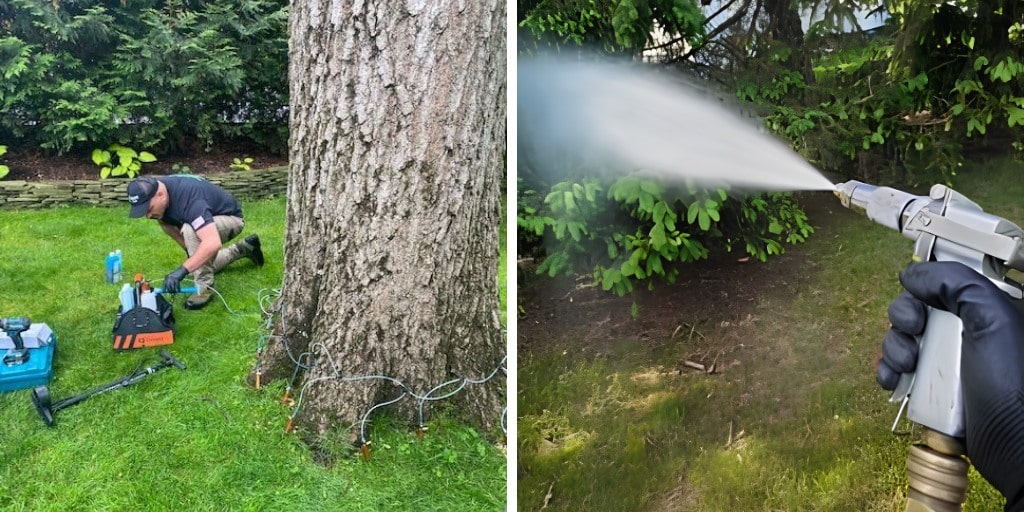
Alpine’s certified arborists deliver iron chlorosis and Plant Health Care treatments throughout Union County—including trunk injection (left) and foliar spray applications (right) tailored to each tree’s diagnosis.
Combat Pin Oak Problems in Union County with Alpine Tree
A struggling pin oak in Summit or Berkeley Heights is rarely a mystery; it’s almost always iron chlorosis. For Union County homeowners with mature pin oaks, ongoing professional care is what protects years of canopy that can’t be replaced quickly. Alpine’s Certified Arborists serve Summit, Berkeley Heights, and the rest of Union County.
We love speaking with our customers directly, so if you have potential pin oak problems on your New Jersey property, reach out to the Alpine Tree team today to request an appointment or call 973-964-7798.
Table of Contents
Add a header to begin generating the table of contents


